Your shopping bag is empty.
Explore productsBuyer guides
Wholesale Copper and Brass Jewelry: Price, Labels and Where It Fits
By Alex, Founder, AdornTrade 2026-08-31 7 min read
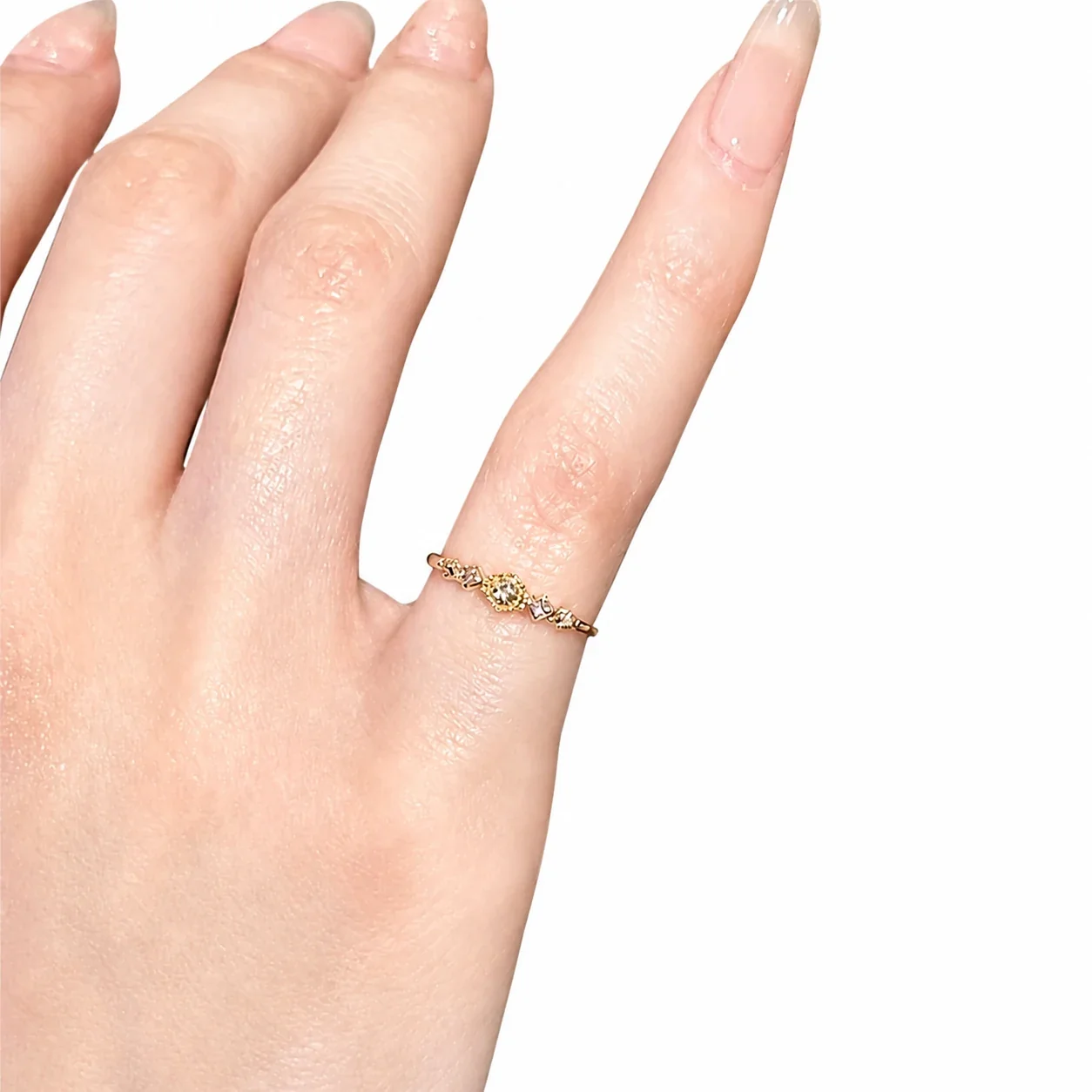
Copper is the cheapest finished jewelry a wholesale catalogue carries, and that fact gets them dismissed. The reasoning goes: cheap goods, cheap margins, not a serious category. The arithmetic says the opposite. Cheap goods are where percentage margins are widest and where testing a new style costs almost nothing — which makes this the correct material to be wrong in.
This guide covers what wholesale copper jewelry actually costs, why the label on it varies so much between suppliers, and where it fits against the other materials in a small buyer’s range.
What copper and brass cost at wholesale
Our copper and brass family runs to 214 published listings as of 1 September 2026. The full spread, per piece:
| Product type | Listings | Lowest | Median | Highest |
|---|---|---|---|---|
| Earrings | 24 | $0.45 | $1.05 | $2.62 |
| Rings | 120 | $0.63 | $1.16 | $3.10 |
| Necklaces | 41 | $1.07 | $1.55 | $4.29 |
| Bracelets | 28 | $1.07 | $2.06 | $4.71 |
| Pendants | 1 | $2.86 | $2.86 | $2.86 |
| All copper and brass | 214 | $0.45 | $1.25 | $4.71 |
The striking thing is not how low the floor is but how narrow the whole range is. From cheapest to dearest the family spans about ten times, $0.45 to $4.71. Our silver family spans from $3.41 to $603.84, which is roughly a hundred and seventy times. That narrowness is the commercially useful property: it means a mistake in this family is bounded. The dearest style you could pick costs $4.71 and the cheapest $0.45, so the decision is about what sells rather than about what you can afford to risk.
Note also that 120 of the 214 listings are rings — this is by some distance the deepest single shelf we have in any material. If rings are what you sell, this is the family with the most to choose from.
Why the margin arithmetic favours the cheap end
Retail pricing does not scale linearly with wholesale cost, because a customer’s willingness to pay for a fashion ring is anchored to what fashion rings cost, not to what the metal cost you. That gap is where the percentage margin lives, and it is widest at the bottom.
At the 8-piece quantity step — 81.25% of the single-piece price across all 3,479 published variants in the catalogue — the four families land like this:
| Median ring, by material | 1 piece | 8 pieces |
|---|---|---|
| Copper | $1.16 | $0.94 |
| Stainless steel | $3.52 | $2.86 |
| 925 sterling silver | $8.06 | $6.55 |
| Moissanite | $19.95 | $16.21 |
Whatever retail price your shelf supports, the gross per unit is that price minus the figures above — and the copper line keeps $5.61 more of it per ring than the silver line does, at every retail price you might set. Which of the two is the better product and which is the better business are separate questions, and they have different answers.
This is also why the copper shelf is the right place to run experiments. Eight pieces of a median copper ring is $7.52 of stock. If it does not sell you have lost the price of lunch, and you have learned something you would otherwise have paid $52.40 to learn in silver.
What the label actually tells you
“Copper,” “brass,” and “bronze” describe different metals, and supplier listings use them loosely — frequently interchangeably within a single catalogue. Brass is copper and zinc; bronze is copper and tin; and a great deal of what is sold under one of those names is another of them.
Our shelf is named Copper & Brass because all three are accepted at intake, but it is worth being precise about what is actually on it: every one of the 214 published listings in this family carries the reviewed material label Copper. Not one is labelled brass or bronze today. A source whose material statements conflict with each other — one field saying copper and another saying alloy, or a title and a specification that disagree — goes to manual review rather than being resolved by picking the more flattering name, and that is why the shelf name is broader than its current contents.
Two consequences worth knowing when you compare suppliers:
- A gold-coloured piece in this family is plated. Copper is already warm-toned, so a bright gold finish on it is a coating, and a catalogue that says plating where plating applies is being straight with you.
- The material name is not a quality grade. Unlike silver, there is no number here that a supplier can be measured against — no 925 equivalent. Which means the check that works on silver does not transfer, and you are relying on the supplier’s material policy rather than on arithmetic.
We publish no coating thickness, durability, wear or compliance claims on these items, because a supplier record is not independent testing. If a competing catalogue does publish such claims, the useful question is which document they come from.
Where copper and brass fit in a range
Set against the other four families by median finished piece: copper $1.25, stainless steel $4.24, natural stone $4.76, 925 sterling silver $11.53, moissanite $19.24.
Each does a different job in a range. Copper covers price-led customers and impulse purchases, and it is where you put breadth — the most styles for the least committed capital. Steel covers the middle, where a piece needs to feel substantial. Silver serves customers who came in asking for silver and will not accept a substitute. Trying to make one material do all three jobs is the most common range-building error, and copper is usually the one left out, on the grounds that it is cheap.
A worked example at the 8-piece step, spending under fifty dollars entirely inside this family:
| Line | Unit at 8+ | Qty | Line total |
|---|---|---|---|
| Median copper earrings | $0.85 | 8 | $6.80 |
| Median copper ring | $0.94 | 8 | $7.52 |
| Median copper necklace | $1.26 | 8 | $10.08 |
| Median copper bracelet | $1.67 | 8 | $13.36 |
| Total | 32 | $37.76 |
Thirty-two pieces across four product types for $37.76 of goods. Shipping is quoted separately at checkout against the destination. There is no other material in the catalogue where a four-category test costs less than forty dollars, and that is the entire argument for the family.
What to check before ordering
- Know which product you are being shown. Searching for copper necklaces at wholesale returns three different businesses in one list: finished fashion jewelry, loose beads and findings sold for assembly, and chain sold by the foot. They are priced on different bases and comparing across them tells you nothing. This catalogue is finished goods only.
- Read the material field, not the title. Copper, brass and bronze are different alloys; a catalogue that uses one word for all three has not reviewed them.
- Treat gold colour as plating unless the listing says otherwise, and prefer catalogues that use the word.
- Check the depth of the shelf you sell from. Breadth is the reason to buy this family; 120 rings is a shelf you can reorder from, and a family with eight of everything is not.
- Do not carry the silver check across. There is no metal-content floor here to price against, so supplier policy replaces arithmetic.
- Spend the saving on width, not depth. Eight each of four styles beats thirty-two of one, because the point of a cheap material is to buy information.
The shelves referenced here: copper and brass, copper rings, copper earrings, and for the price contrast, stainless steel and 925 sterling silver. The order quantity page sets out the quantity steps.
The short version
Copper and brass costume jewelry is the cheapest way to find out what your customers buy, and finding that out is worth more early on than owning better stock. A whole four-category test runs under forty dollars. The label deserves more attention than the price does, because unlike silver there is no number here to check a supplier against — only whether the catalogue tells you which of the three metals a piece actually is, when merging them under one friendly word would have been easier.
Accuracy reviewed by: Alex, Founder, AdornTrade
Sources
From the catalogue