Your shopping bag is empty.
Explore productsBuyer guides
Moissanite Color and Clarity Grades: How to Read D, VVS1 and Carat-to-mm Labels
By Alex Hou, Founder, AdornTrade 2026-10-04 9 min read
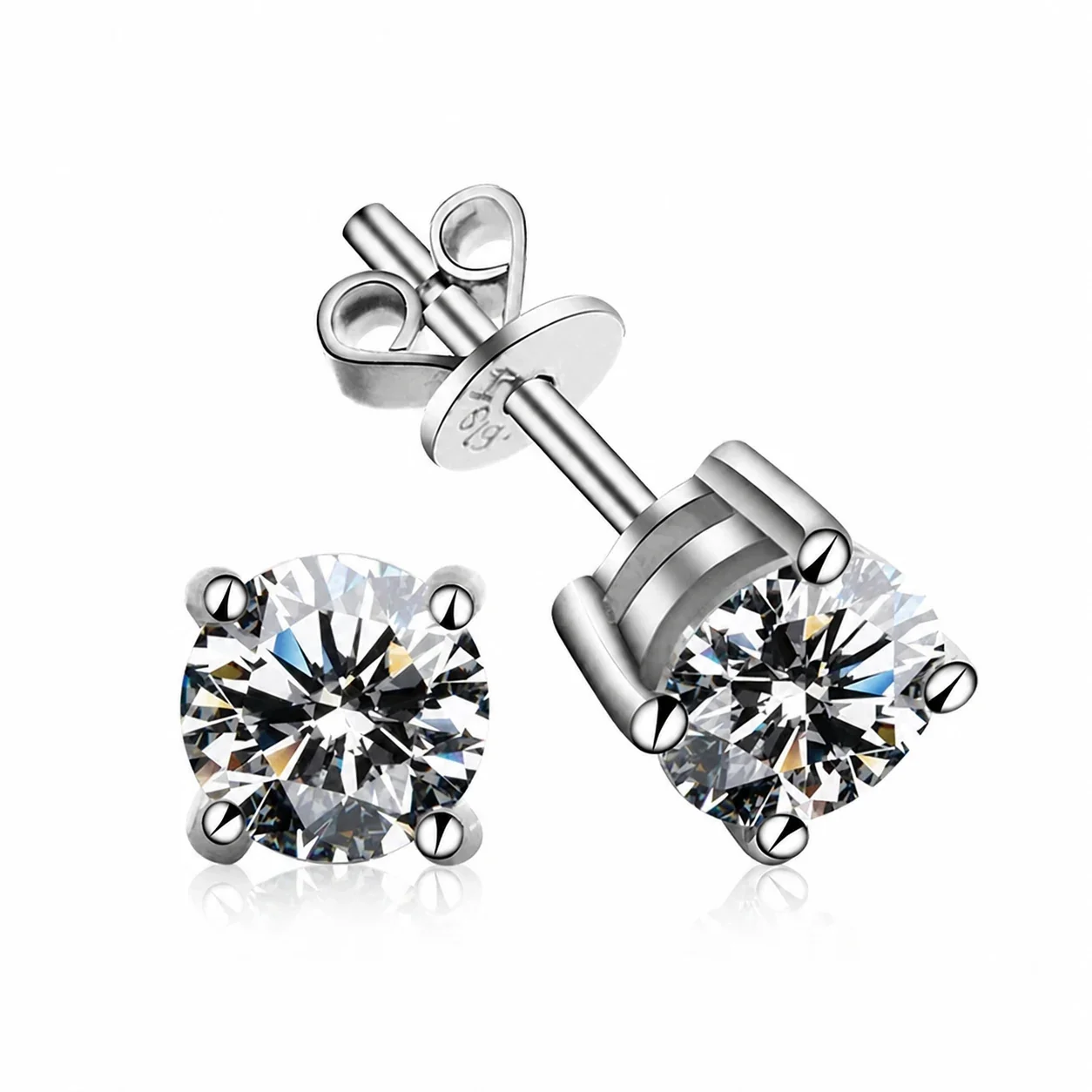
Moissanite color grades use the letters of GIA's diamond color scale: D, E and F mean colorless, and G, H and I are sold as near-colorless (GIA's own near-colorless band runs G to J). Clarity grades use GIA's diamond clarity names, from FL and IF down through VVS1, VVS2, VS1 and VS2. The letters on a moissanite card are not GIA grades. They were assigned by the stone's producer, the seller or whoever issued the card, and Charles & Colvard's DEF and GHI labels are the best-known example. Carat on moissanite usually means diamond equivalent weight (DEW). A 6.5 mm round moissanite is sold as "1 ct", but on a scale it weighs about 0.88 ct.
Below we go through color, clarity, cut and carat in turn and list the physical constants that set moissanite apart from diamond. There is a moissanite carat to mm chart taken from the Charles & Colvard size chart, followed by a count, as of 4 October 2026, of the grade and carat labels used in the AdornTrade moissanite catalogue.
Moissanite color grades: what D, E, F and G, H, I mean
GIA's diamond color scale has 23 grades, from D to Z, split into five groups. A diamond gets its grade when it is compared with stones of known color under controlled lighting. When these letters appear on moissanite, they are being used for a material the scale was never written for.
| GIA group | Letters | Grades in group | How the letters appear on moissanite |
|---|---|---|---|
| Colorless | D–F | 3 | Charles & Colvard Forever One, launched 8 September 2015 as "colorless (D-E-F)" |
| Near colorless | G–J | 4 | Charles & Colvard Forever Brilliant, "near-colorless (G-H-I)" |
| Faint | K–M | 3 | Charles & Colvard Forever Classic, "faint color (J-K)" |
| Very light | N–R | 5 | Not used in moissanite marketing we found |
| Light | S–Z | 8 | Not used in moissanite marketing we found |
The table shows that the two scales do not line up exactly. GIA puts J in the near-colorless group. Charles & Colvard's 2015 announcement grouped J with K as "faint color". So when you read a moissanite color grade, you are reading the issuer's own bands, written in GIA's letters.
D color moissanite. D is the top letter of the diamond scale. It is also the color letter that appears in our suppliers' listings (see the counts below). Charles & Colvard says Forever One "is considered colorless by GIA standards, and is graded in the D-E-F range". Note who is saying this: it is the producer describing its own stone against GIA's standards, and GIA is not the issuer of that grade. IGI is a laboratory that does grade moissanite: in 2024 it began issuing reports for Charles & Colvard stones. According to JCK's 23 May 2024 report, IGI gives individual color grades to D and E stones only, labels F stones "colorless" and labels G–H stones "near colorless".
Moissanite clarity grades and what VVS1 moissanite means
GIA defines 11 clarity grades in six categories, judged by a skilled grader at 10× magnification:
| Grade | GIA name | GIA definition (10× magnification) |
|---|---|---|
| FL | Flawless | No inclusions or blemishes visible |
| IF | Internally Flawless | No inclusions; only blemishes visible |
| VVS1, VVS2 | Very, Very Slightly Included | Inclusions difficult for a skilled grader to see |
| VS1, VS2 | Very Slightly Included | Inclusions minor, difficult to somewhat easy to see |
| SI1, SI2 | Slightly Included | Inclusions noticeable |
| I1, I2, I3 | Included | Inclusions obvious; may affect transparency and brilliance |
What does VVS1 moissanite mean? It means the card's issuer considers the stone to be in the upper half of GIA's VVS category: inclusions are difficult for a skilled grader to see even at 10× magnification. On the GIA scale VVS1 ranks third of 11, directly below FL and IF. There are three limits to keep in mind:
- GIA does not assign these grades to moissanite. In a Fall 2020 lab note on a 1.02 ct synthetic moissanite with a fraudulent GIA inscription, GIA wrote that its clarity "would have been equivalent to VVS2 (if such clarity grades were assigned to synthetic moissanite)". GIA used the diamond terms only for comparison.
- The grade belongs to whoever printed it. IGI applies "its regular standards for clarity and cut" to the moissanite it grades, and it laser-inscribes every stone. A card from any other issuer uses that issuer's own judgement. Read about what a GRA card records, and how to check its number, in our GRA certificate guide.
- Producers set their own minimum. JCK reported in 2024 that Charles & Colvard had raised the minimum clarity for Forever One to VVS, up from VS. VVS is a floor that a manufacturer chose. It is not a standard of the material.
Cut, and the physical numbers behind moissanite's look
GIA's cut grade, which runs from Excellent to Poor, is defined for standard round brilliant diamonds in the D-to-Z range. It looks at brightness, fire and scintillation, along with weight ratio, durability, polish and symmetry. When a moissanite card prints "Excellent" for cut, polish or symmetry, it is borrowing these terms in the same way it borrows the color letters. Charles & Colvard says its stones are cut to "exact angles and proportions designed especially for moissanite", and its round brilliant has 58 facets.
The properties that do not depend on anyone's judgement are the physical constants. These are the measured values:
| Property | Moissanite | Diamond | Source |
|---|---|---|---|
| Refractive index | 2.648 and 2.691 (two values; quoted as 2.65–2.69) | 2.417 (2.42) | GIA 1997; Charles & Colvard |
| Birefringence | 0.043 (doubly refractive) | None (singly refractive) | GIA 1997 |
| Dispersion ("fire") | 0.104 | 0.044 | GIA 1997; Charles & Colvard |
| Mohs hardness | 9¼ (9.25) | 10 | GIA 1997; Charles & Colvard |
| Specific gravity | 3.22 | 3.52 | GIA 1997 |
Dispersion is why moissanite shows more rainbow flashes than diamond: 0.104 is about 2.4 times diamond's 0.044, which is the ratio Charles & Colvard quotes. Double refraction is the clue a gemologist looks for. Viewed through the crown at an angle, the back facet edges of moissanite appear doubled. The specific gravity row explains the carat question in the next section. Moissanite is about 8.5% less dense than diamond (3.22 against 3.52), so a stone of the same size weighs less. For a side-by-side that also covers cubic zirconia, see moissanite vs diamond vs cubic zirconia.
Moissanite carat to mm: DEW against actual weight
The moissanite trade quotes carat as diamond equivalent weight (DEW). DEW is the weight a round diamond of the same diameter would have. Charles & Colvard puts it directly: "a 6.5mm round diamond would weigh 1.0 ct, while a 6.5mm round moissanite would weigh 0.88 ct." GIA's 1997 study gave a similar result: about 1.00 ct for a 6.50 mm diamond and about 0.91 ct for a moissanite of the same diameter and cut. The round brilliant rows below come from the Charles & Colvard Shapes and Sizes Chart, which gives both figures:
| Diameter (round) | DEW (ct) | Actual moissanite weight (ct) |
|---|---|---|
| 3.0 mm | 0.10 | 0.09 |
| 4.0 mm | 0.23 | 0.22 |
| 5.0 mm | 0.50 | 0.41 |
| 6.0 mm | 0.80 | 0.68 |
| 6.5 mm | 1.00 | 0.88 |
| 7.0 mm | 1.20 | 1.10 |
| 7.5 mm | 1.50 | 1.35 |
| 8.0 mm | 1.90 | 1.60 |
| 8.5 mm | 2.20 | 1.90 |
| 9.0 mm | 2.70 | 2.26 |
| 9.5 mm | 3.10 | 2.75 |
| 10.0 mm | 3.60 | 3.08 |
| 11.0 mm | 4.75 | 4.11 |
Read against the common sizes on this chart, 0.5 ct DEW is 5.0 mm, 1 ct DEW is 6.5 mm and 1.5 ct DEW is 7.5 mm. A "2 ct" round falls between 8.0 mm (1.90) and 8.5 mm (2.20), and a "3 ct" round falls between 9.0 mm (2.70) and 9.5 mm (3.10). Charles & Colvard calls its chart weights approximate averages. Other cuts follow their own rows on the chart. On that chart a 6.5 mm cushion is 1.30 ct DEW, for example. The diameter in millimetres is the figure you can check with a gauge, and it is the one to compare.
How the AdornTrade catalogue labels moissanite
As of 4 October 2026, AdornTrade lists 440 published pieces in its moissanite category. All 440 are made in 925 sterling silver, and every moissanite piece ships with a GRA certificate supplied with the stone. On the card format we have read, the color and clarity letters are printed on that card. The listings themselves mainly describe stone size. Counted directly from the catalogue database that day:
- 192 of 440 listings state a carat figure in at least one option value.
- The most common carat values, counted as listings that offer each value: 1 ct in 106, 0.5 ct in 80, 2 ct in 42, 0.3 ct in 30, 3 ct in 22, 0.1 ct in 13 and 1.5 ct in 5. A listing can offer several sizes.
- 26 listings give millimetres and carat in the same option value, for example "1 ct (6.5 mm)" or "5.0 mm / 0.5 ct".
- 5 listings name D color in their English description or specifications. In the suppliers' original Chinese listings, 67 of the 440 describe the stone as D color (D色) and 2 mention VVS1. The grade letters come from the stone supplier's paperwork.
Here is how the size pairs used on our listings compare with the Charles & Colvard chart at the same diameter:
| Label on AdornTrade listings | C&C DEW at that diameter | C&C actual weight |
|---|---|---|
| 3 mm / 0.1 ct | 0.10 | 0.09 |
| 4 mm / 0.3 ct | 0.23 | 0.22 |
| 5 mm / 0.5 ct | 0.50 | 0.41 |
| 6 mm / 0.8 ct | 0.80 | 0.68 |
| 6.5 mm / 1 ct | 1.00 | 0.88 |
| 7.5 mm / 1.5 ct | 1.50 | 1.35 |
| 8 mm / 2 ct | 1.90 | 1.60 |
| 9 mm / 3 ct | 2.70 | 2.26 |
| 10 mm / 4 ct | 3.60 | 3.08 |
| 11 mm / 5 ct | 4.75 | 4.11 |
Up to 7.5 mm, the trade labels match the Charles & Colvard DEW figures except at 4 mm. From 8 mm upward the trade label is a rounded size name, higher than the chart's DEW. So compare stones by millimetres, and read the carat figure as a size name. You can browse by size in moissanite rings and moissanite earrings, or see trade terms on the wholesale moissanite jewelry page.
Notes for retailers explaining grades to customers
- Give the size in millimetres first. "6.5 mm round, sold as 1 ct diamond-equivalent" is accurate. "1 carat" with nothing else will mislead a customer who weighs the stone.
- Name the issuer of the grade. "D color, VVS1 on the enclosed GRA card" tells the customer where the grade came from. "D color VVS1" alone sounds like a GIA diamond grade.
- Explain that the letters are borrowed. D–F and G–I are the diamond scale's colorless and near-colorless bands. On moissanite they describe appearance as judged by the issuer.
- Use the physical constants when asked "is it as hard as diamond?" The answer is 9¼ on the Mohs scale against 10, and dispersion is 0.104 against 0.044.
- Keep the card with the piece. The report number is the reference for after-sales questions and reorders.
Accuracy reviewed by: Alex Hou, Founder, AdornTrade
Sources
- GIA Gems & Gemology Winter 1997 — Nassau, McClure, Elen, Shigley, "Synthetic Moissanite: A New Diamond Substitute" (RI 2.648/2.691, birefringence 0.043, dispersion 0.104, Mohs 9¼, SG 3.22; diamond RI 2.417, dispersion 0.044, SG 3.52; 6.50 mm diamond ≈1.00 ct vs moissanite ≈0.91 ct)
- Charles & Colvard — Moissanite 101 (RI 2.65–2.69 vs 2.42; 2.4× diamond's dispersion 0.044; hardness 9.25; 6.5 mm round moissanite 0.88 ct vs diamond 1.0 ct)
- Charles & Colvard Created Moissanite — Shapes and Sizes Chart (PDF; moissanite average carat weight and diamond equivalent weight by mm; round brilliant 58 facets)
- Charles & Colvard — Introducing Forever One ('considered colorless by GIA standards, and is graded in the D-E-F range')
- PR Newswire, 2015 — Charles & Colvard Forever One launch (colorless D-E-F; Forever Brilliant near-colorless G-H-I; Forever Classic faint color J-K; on sale 8 September 2015)
- JCK, 23 May 2024 — IGI to Issue Grading Reports for Moissanite (D and E individually graded, F 'colorless', G–H 'near colorless'; all laser-inscribed; Forever One minimum clarity raised to VVS)
- GIA — Diamond Clarity: the GIA Clarity Scale (11 grades in 6 categories at 10× magnification)
- GIA 4Cs — Diamond Color Chart: The Official GIA Color Scale (23 grades; D–F, G–J, K–M, N–R, S–Z)
- GIA — Diamond Cut (Excellent to Poor; standard round brilliants in the D-to-Z range; brightness, fire, scintillation, weight ratio, durability, polish, symmetry)
- GIA Lab Notes, Fall 2020 — Synthetic Moissanite with Fraudulent GIA Inscription (1.02 ct; clarity 'would have been equivalent to VVS2 (if such clarity grades were assigned to synthetic moissanite)')
From the catalogue