Your shopping bag is empty.
Explore productsBuyer guides
Moissanite vs Lab-Grown Diamond: Properties, Testers and Naming Rules
By Alex Hou, Founder, AdornTrade 2026-10-04 10 min read
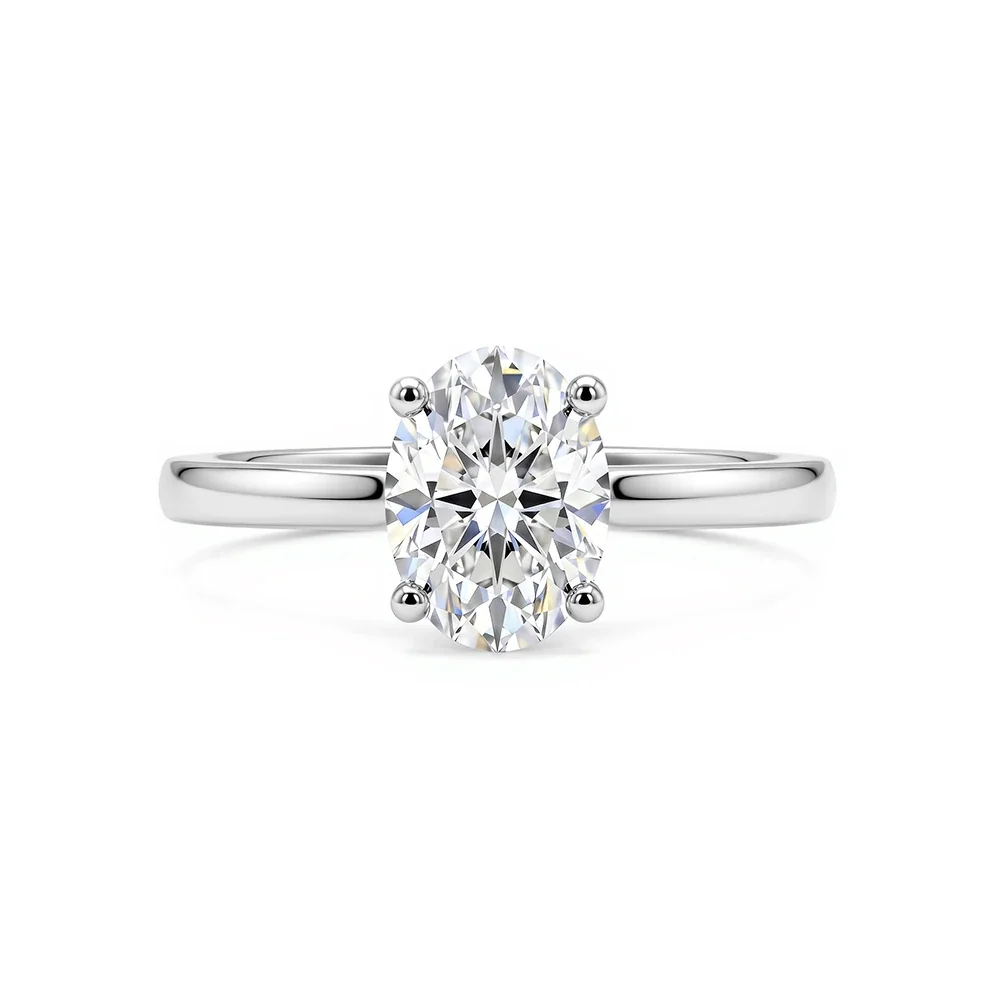
Is moissanite a lab-grown diamond? No. Moissanite is silicon carbide (SiC); a lab-grown diamond is carbon (C) with essentially the same optical, physical and chemical properties as a mined diamond. In the moissanite vs lab grown diamond comparison the measurable differences are hardness (Mohs 9¼ against 10), refractive index (2.648–2.691 against 2.417), dispersion or "fire" (0.104 against 0.044), specific gravity (3.22 against 3.52) and double refraction, which makes facet edges look doubled in moissanite and never in diamond. A standard thermal diamond tester reads moissanite as "diamond"; an electrical-conductivity or multi-tester usually separates them, with known exceptions covered below.
This page puts the published numbers side by side, explains what each tester can and cannot tell you, sets out the US Federal Trade Commission naming rules for lab-grown diamonds and for stones that are not diamonds, and gives retailers a plain way to explain the choice to customers. Figures for our own moissanite range are taken from the AdornTrade catalogue as of 4 October 2026.
Moissanite vs lab-grown diamond vs natural diamond: the numbers
The gemmological values below come from the Gemological Institute of America (GIA) study Synthetic Moissanite: A New Diamond Substitute (Gems & Gemology, Winter 1997), GIA's diamond care guidance, and the FTC definition of diamond in 16 CFR 23.12. Lab-grown and natural diamond share one column of physical values because the FTC treats a laboratory-created diamond as having "essentially the same optical, physical, and chemical properties as mined diamonds".
| Property | Moissanite | Lab-grown diamond | Natural (mined) diamond |
|---|---|---|---|
| Chemical composition | Silicon carbide, SiC | Carbon, C | Carbon, C |
| Crystal system | Hexagonal (6H polytype in the GIA samples), uniaxial | Isometric (cubic) | Isometric (cubic) |
| Mohs hardness | 9¼ (Charles & Colvard: 9.25) | 10 | 10 |
| Refractive index | 2.648 and 2.691 | 2.417 (FTC: 2.42) | 2.417 (FTC: 2.42) |
| Birefringence (double refraction) | 0.043 | None (singly refractive) | None (singly refractive) |
| Dispersion ("fire") | 0.104 | 0.044 | 0.044 |
| Specific gravity | 3.22 (precision density 3.224) | 3.52 | 3.52 |
| Weight of a 6.50 mm round brilliant | About 0.91 ct (GIA); 0.88 ct at 6.5 mm (Charles & Colvard) | About 1.00 ct | About 1.00 ct |
| Behaviour in heat (in air) | Reported stable to 1,700 °C (3,092 °F) | Burns at about 850 °C (1,562 °F) | Burns at about 850 °C (1,562 °F) |
| Thermal diamond tester | Reads "diamond" | Reads "diamond" | Reads "diamond" |
| Electrical conductivity | 13 of 23 GIA samples conducted | Near-colourless stones normally do not; many HPHT-grown stones with boron do | Near-colourless stones normally do not; some blue or grey stones do |
Two points in that table are easy to misread. First, the Mohs scale is ordinal, not linear: GIA notes that the gap in Knoop indentation hardness between corundum (Mohs 9) and moissanite (Mohs 9¼) is larger than the gap between corundum and topaz (Mohs 8). On that indentation scale diamond at 10 is still far harder than moissanite at 9¼. Second, the weight row matters when you compare listings. Because moissanite is about 8.5% less dense than diamond, a moissanite cut to the same 6.50 mm diameter weighs less, which is why moissanite is often sold by millimetre size or by "diamond-equivalent" carat rather than by its own scale weight.
How moissanite looks different from a diamond
Rainbow fire
Dispersion is the splitting of white light into spectral colours. Moissanite's dispersion of 0.104 is about 2.4 times diamond's 0.044, which is the figure Charles & Colvard publishes. In daylight or under spotlights this shows as larger flashes of rainbow colour, which some customers want and others read as "not diamond-like". A lab-grown diamond and a natural diamond of the same cut show the same amount of fire as each other, because they share the 0.044 value.
Doubled facet edges
Moissanite is doubly refractive with a birefringence of 0.043. Looking through the crown at an angle with a 10x loupe, the pavilion facet junctions appear doubled. GIA found that all 23 of its study stones were cut with the optic axis perpendicular to the table, so looking straight down through the table shows no doubling; tilting the stone, or focusing past the culet, brings it out. Diamond, lab-grown or mined, is singly refractive in every direction and never shows this doubling. GIA also recorded rounded facet junctions and fine, parallel needle-like inclusions in most of its moissanite samples, against the sharp facet junctions of diamond.
Colour
The 18 GIA samples above 0.20 ct ranged from about I (near-colourless) down to U–V on the diamond colour scale, often with grey or green tints. That describes 1997 production; the colour of any stone sold today is a matter of that stone and its paperwork, covered in our guide to GRA moissanite certificates.
Moissanite vs diamond tester: thermal, electrical and multi-testers
Most "pen" testers measure one of two things, and the results differ by stone.
- Thermal (heat) testers. GIA measured the thermal inertia ranges of diamond and moissanite as overlapping (0.55–1.7 for diamond and 1.6–4.8 for moissanite on the scale it cited). In its study, every one of the 23 moissanites registered as "diamond" on all 4 thermal instruments used. A thermal tester therefore separates both diamond and moissanite from cubic zirconia and glass, but cannot tell moissanite from diamond.
- Electrical-conductivity testers. Many moissanites conduct electricity; near-colourless diamonds normally do not. In GIA's study 13 of the 23 samples showed some conductivity, and GIA called conductivity "an indication, but not diagnostic". The exceptions run the other way too: natural blue (boron-bearing) diamonds conduct, and The Gem Academy reported in 2021 that roughly 70% of near-colourless HPHT lab-grown diamonds in colour grades G and below are semiconductors of electricity, so they can read as "moissanite" on a conductivity tester.
- Multi-testers. Combined testers run the thermal check first and then the electrical check. They are built to answer "diamond, moissanite or simulant?" in one step, but they inherit the conductivity exceptions above, and neither check can say whether a diamond is lab-grown or mined.
The practical rule from GIA's 1997 conclusion still holds: a thermal probe alone is not enough, and a conductive reading on a stone with no doubled facets points to a diamond (often an HPHT lab-grown one) rather than moissanite. Specific gravity is diagnostic (3.22 against 3.52) but needs a loose stone. Telling a lab-grown diamond from a mined diamond is a separate question that needs laboratory spectroscopy, not a handheld moissanite vs diamond tester.
Lab diamond or moissanite: what the FTC naming rules say
The FTC Guides for the Jewelry, Precious Metals, and Pewter Industries (16 CFR Part 23, revisions approved by a 5–0 Commission vote on 24 July 2018) set out how each stone may be described in the United States.
- "Diamond" without a qualifier. Section 23.12(a) defines a diamond as "a mineral consisting essentially of pure carbon crystallized in the isometric system", with hardness 10, specific gravity about 3.52 and refractive index 2.42. Section 23.12(b) makes it unfair or deceptive to use the unqualified word "diamond" for anything that does not meet that definition. Moissanite does not meet it.
- Lab-grown diamonds. A lab-grown diamond meets the physical definition, but the stone name must be "immediately preceded with equal conspicuousness" by "laboratory-grown", "laboratory-created", "[manufacturer name]-created" or a phrase of like meaning (23.25(b)). "Cultured" is allowed only with such a disclosure (23.12(c)(3)), and the FTC states that "faux" is not an adequate disclosure.
- "Lab diamond" on moissanite. Section 23.25(c) makes it unfair or deceptive to put "laboratory-grown", "laboratory-created" or "synthetic" in front of the name of a natural stone unless the product has essentially the same optical, physical and chemical properties as that stone. Silicon carbide differs from diamond on every row of the table above, so moissanite cannot be sold as a "lab diamond", "lab-created diamond" or "moissanite diamond".
- "Natural", "real", "genuine". Section 23.27 makes it unfair or deceptive to use "real", "genuine", "natural" or "precious" for any product "manufactured or produced artificially". That covers both lab-grown diamond and grown moissanite.
- Naming moissanite itself. Natural moissanite was identified by Henri Moissan in the Canyon Diablo meteorite (published in 1904) and named after him by George Kunz in 1905. GIA notes that natural moissanite occurs only in tiny amounts, so the moissanite set in jewellery is grown. Section 23.25(b) asks that a stone name used for a grown stone be preceded by "laboratory-created" or similar. The section does not name moissanite, but our reading is that it applies, so "lab-created moissanite" or "created moissanite" is the more cautious wording for US listings.
Price: what has changed and what we can state
We publish price figures only where they have a dated source. For lab-grown diamonds, JCK reported on 19 March 2025 that, according to analyst Paul Zimnisky, wholesale lab-grown diamond prices were down 90% to 95% compared with 2015, and that a colourless VS 3 ct lab diamond could be bought at wholesale for about $300. When GIA examined the first jewellery moissanite in 1997, its maker planned to price it at 5% to 10% of the average retail price of comparable diamonds; that ratio described mined diamonds in 1997 and should not be applied to lab-grown diamonds today.
For moissanite we can state our own catalogue. As of 4 October 2026 AdornTrade lists 440 moissanite designs, all set in 925 sterling silver, and each ships with a GRA certificate supplied with the stone. These are 1-piece wholesale prices in US dollars (the price of each design's lowest-priced option; 3+ and 8+ quantity tiers are lower):
| Moissanite range (as of 4 October 2026) | Designs | Lowest 1-piece price | Median 1-piece price | Highest 1-piece price |
|---|---|---|---|---|
| All moissanite jewellery | 440 | $4.77 | $19.04 | $172.06 |
| Moissanite earrings | 150 | $4.77 | $14.99 | $45.34 |
| Moissanite rings | 137 | $8.07 | $20.24 | $91.16 |
| Moissanite necklaces | 109 | $7.64 | $21.72 | $172.06 |
| Moissanite bracelets | 33 | $10.26 | $26.25 | $167.77 |
Half of the 440 designs have a 1-piece price between $14.56 and $25.25. For the most common comparison question, a 1-carat stone: 28 of our ring designs offer a "1 ct moissanite" option, across 146 size and cut variants, priced from $10.45 to $34.84 per piece with a median of $20.95, including the 925 silver ring. These are trade prices for complete pieces, not loose-stone prices, and they are not a retail price guide.
For retailers: explaining the choice to customers
Customers who ask "lab diamond or moissanite?" usually want a fair comparison, not a sales pitch for either stone. A script that stays accurate:
- Start with what each stone is. "A lab-grown diamond is a diamond made in a factory: carbon, hardness 10, the same as a mined diamond. Moissanite is a different stone, silicon carbide, hardness 9¼."
- Show the look, then let them choose. Put both under the same light. Moissanite shows about 2.4 times the rainbow fire of a diamond. Some customers want that colour and some prefer the quieter look of diamond; it is a preference, not a ranking.
- Mention testers before the customer finds out. Tell buyers that a basic heat tester will beep "diamond" on moissanite, and that a multi-tester or a jeweller with a loupe can tell them apart. A customer who hears this from you first is not surprised later.
- Size by millimetre. Quote moissanite as "6.5 mm, about 1 carat diamond-equivalent" so the customer is comparing the same visible size.
- Use the FTC wording on tags and listings. "Lab-grown diamond" or "laboratory-created diamond" for diamonds; "lab-created moissanite" for moissanite (the cautious reading of 23.25(b)); never "diamond" alone for moissanite, and not "natural" or "real" for either grown stone.
- Hand over the paperwork as what it is. A GRA card records the stone's size and grades as supplied; see our GRA certificate guide for how to read and look up the number.
For trade quantities, our wholesale moissanite jewellery page lists the current range by category with 1-piece, 3-piece and 8-piece prices. For a three-way comparison that adds cubic zirconia, see moissanite vs diamond vs cubic zirconia.
Accuracy reviewed by: Alex Hou, Founder, AdornTrade
Sources
- GIA Gems & Gemology Winter 1997 — Nassau, McClure, Elen, Shigley, "Synthetic Moissanite: A New Diamond Substitute" (RI 2.648/2.691, birefringence 0.043, dispersion 0.104, Mohs 9¼, SG 3.22; diamond RI 2.417, dispersion 0.044, SG 3.52; all 23 samples read 'diamond' on 4 thermal instruments; 13 of 23 conductive, 'an indication, but not diagnostic'; 6.50 mm ≈1.00 ct diamond vs ≈0.91 ct moissanite; stable in air to 1700 °C; Moissan 1904 / Kunz 1905; maker's 5%–10% price plan)
- GIA — Diamond Care and Cleaning Guide (Mohs 10; 'Diamonds will burn at about 1562°F (850°C)')
- eCFR — 16 CFR 23.12 Definition and misuse of the word "diamond" (carbon, isometric, hardness 10, SG 3.52, RI 2.42; unqualified 'diamond'; 'cultured' with laboratory-created disclosure)
- eCFR — 16 CFR 23.25 Misuse of the words ruby, sapphire, emerald, topaz, stone, gem, etc. ('laboratory-grown'/'laboratory-created' qualifiers; 'faux' not adequate; lab-created name only for same properties)
- eCFR — 16 CFR 23.27 Misuse of the words real, genuine, natural, precious, etc.
- FTC press release, 24 July 2018 — FTC Approves Final Revisions to Jewelry Guides (5–0 vote)
- JCK, 19 March 2025 — "The Narrative About Lab-Grown Diamonds Is Changing" (Paul Zimnisky: wholesale lab-grown prices down 90%–95% vs 2015; colorless VS 3 ct at wholesale for $300)
- The Gem Academy (Julia Griffith FGA DGA), 16 March 2021 — HPHT laboratory-grown diamonds that test as synthetic moissanite due to boron (~70% of near-colourless HPHT LGD, G and below, are semiconductors)
- Charles & Colvard — Moissanite 101 (RI 2.65–2.69; 2.4 times the fire of diamond 0.044; Mohs 9.25; 6.5 mm moissanite 0.88 ct vs 1.0 ct diamond)
- Charles & Colvard — Moissanite vs Lab Created Diamonds (silicon carbide vs carbon; Mohs 9.25–9.5 vs 10; RI 2.65–2.69 vs 2.42)
- Légifrance — Décret n° 2002-65 du 14 janvier 2002 relatif au commerce des pierres gemmes et des perles, article 4 (qualificatif « synthétique » ; termes « élevé », « cultivé », « de culture », « vrai », « précieux », « fin », « véritable », « naturel » interdits ; version en vigueur depuis le 1er février 2002)
- Assemblée nationale — Question écrite n° 5268 (17e législature), « Révision de la terminologie des diamants synthétiques », réponse du ministère de l’Économie publiée le 3 juin 2025 (« arbitré, à l’automne 2023, en faveur de l’absence de modification dudit décret »)
From the catalogue