Your shopping bag is empty.
Explore productsBuyer guides
Moissanite vs Diamond vs Cubic Zirconia: What Actually Differs
By Alex, Founder, AdornTrade 2026-09-11 6 min read
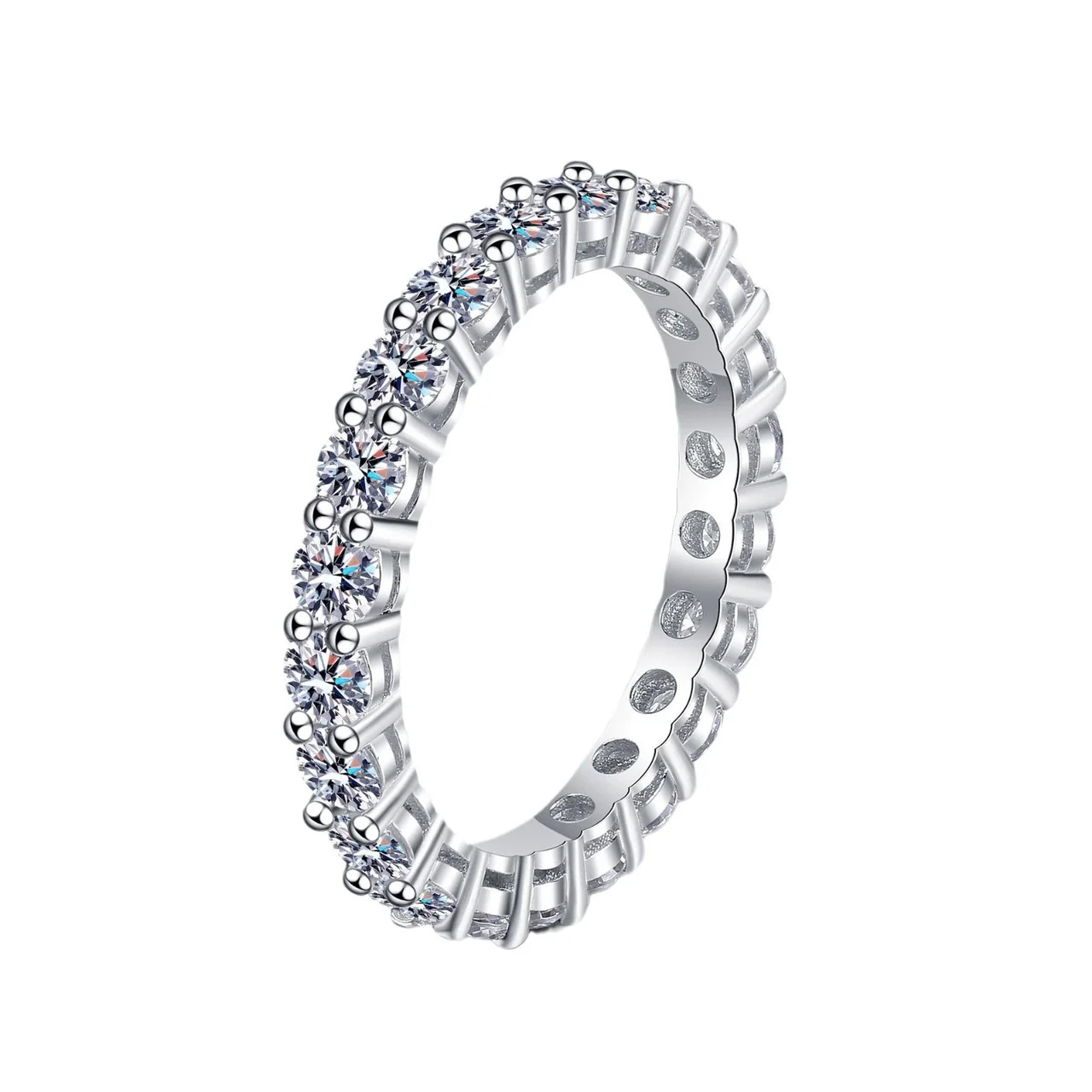
Moissanite, diamond and cubic zirconia get sold side by side and photograph almost identically, which is exactly why buyers ask for the difference before they commit stock. The three stones are different materials with different measured physical properties, different price behaviour and different failure modes on a shop floor. This page sets out the measurable differences, then shows what moissanite actually costs and how it is actually set, using the 255 moissanite products currently published in the AdornTrade catalogue.
What moissanite actually is
Moissanite is silicon carbide, chemical formula SiC. It occurs naturally — it was first identified in a meteorite crater — but natural crystals are far too small and too rare for jewellery, so the stones sold in the trade are laboratory grown, with natural material confined to mineral collections. That is a material fact, not a quality judgement: a grown silicon carbide crystal is still silicon carbide.
Diamond is crystalline carbon. Cubic zirconia is the cubic crystalline form of zirconium dioxide, ZrO2, and is also entirely laboratory grown. So of the three, only diamond is routinely sold as a mined natural stone, and two of the three are synthetic by definition rather than by grade.
The measurable differences
These are published physical constants, not marketing positions. The figures below come from the mineralogical data cited at the foot of this page.
| Property | Moissanite | Diamond | Cubic zirconia |
|---|---|---|---|
| Composition | SiC (silicon carbide) | C (carbon) | ZrO2 |
| Mohs hardness | ~9.5 | 10 (the defining mineral) | 8.0–8.5 |
| Refractive index | 2.654 and 2.967 | 2.418 at 500 nm | 2.15–2.18 |
| Double refraction | Yes — two indices | No — single index | No — single index |
| Density (g/cm³) | 3.218–3.22 | 3.52 ± 0.01 | 5.6–6.0 |
| Origin in trade | Laboratory grown | Mined or laboratory grown | Laboratory grown |
Read as a buying decision, moissanite vs diamond is mostly a question of documentation and cost base, while moissanite vs cubic zirconia is a question of hardness and density. Three of those rows matter commercially:
- Density. Cubic zirconia is roughly 1.8 times as dense as moissanite. Two stones cut to the same millimetre dimensions will not weigh the same, which is why stone size in this category is quoted in millimetres or in "carat equivalent" rather than in actual carat weight. A 6.5 mm round moissanite and a 6.5 mm round cubic zirconia are the same size and different weights.
- Double refraction. Moissanite has two refractive indices, 2.654 and 2.967; diamond has one. Under magnification that produces visible doubling of the back facet edges. It is the standard way a trade buyer separates the two, and it is the reason a moissanite stone cannot be honestly sold as diamond.
- Hardness. On the Mohs scale moissanite sits at about 9.5 against diamond at 10 and cubic zirconia at 8.0–8.5. Mohs is an ordinal scratch-resistance scale, not a linear one, and it says nothing about how a stone behaves when struck. It is a useful comparison between these three and a poor basis for any durability promise.
Why moissanite is nearly always set in sterling silver
A stone this hard is usually paired with a metal that can hold it. In practice the volume market settles on 925 sterling silver, and our own catalogue is an unusually clean example: of the 255 published moissanite products on AdornTrade, the reviewed material label on all 255 is 925 sterling silver. There is no second base metal in the moissanite range at all.
That has a practical consequence for anyone buying to resell. A moissanite listing is really two material questions — the stone and the metal holding it — and only one of them is the stone. A supplier who will state the stone but not the base metal has answered half the question. On our own listings the base metal is recorded per SKU rather than inferred from the category name, which is why the moissanite category and the sterling silver category describe the same metal in different words.
The 255 products break down by type as follows: 122 earrings, 68 necklaces, 46 rings, 18 bracelets and 1 set. Earrings are just under half the shelf, which is typical for a stone sold on sparkle rather than on a centre-stone narrative.
What moissanite costs at wholesale
Across the 1,125 published moissanite variants, the single-piece price runs from $6.16 to $136.47, with a median of $19.28. At the 8-piece quantity price the same shelf runs $5.00 to $110.88, median $15.66.
Placed against the other four material families in the same catalogue, on single-piece medians:
| Material family | Published products | Median, 1 piece | Median, 8+ pieces |
|---|---|---|---|
| Copper and brass | 205 | $1.31 | $1.06 |
| Stainless steel | 293 | $4.25 | $3.45 |
| Natural stone and pearl | 201 | $4.77 | $3.87 |
| Sterling silver | 207 | $11.12 | $9.03 |
| Moissanite in 925 silver | 255 | $19.28 | $15.66 |
Moissanite is the most expensive shelf in the catalogue, at roughly 14.7 times the copper median and about 1.7 times the plain sterling silver median. The gap against plain silver is close to the cost of the stone and the extra setting work, which is a useful sanity check when a quote looks too low: a 925 silver piece with a set stone that prices below a plain 925 silver piece of similar size is worth a second question about what is actually in it.
What to check before ordering
- Ask what the base metal is, per item. "Moissanite ring" describes the stone. It does not say whether the band is silver, brass or plated steel.
- Ask for stone size in millimetres. Because moissanite and cubic zirconia differ in density by roughly 1.8 times, carat weight is not comparable across stone types. Millimetres are.
- Check the stone count. Pavé and halo designs quote a centre stone size and then a number of accent stones; two listings can share a centre size and differ substantially in total stone content.
- Treat certification claims separately from material labels. A supplier record stating a stone type is a supplier record. It is not an independent gemmological report, and the two should not be quoted to your own customers as if they were the same document.
- Buy one before you buy eight. Our own quantity break starts at 3 pieces and again at 8, so a single-piece test order costs the 1-piece price rather than a sample fee. The moissanite wholesale page lists the current price bands per category.
Which one to stock
Cubic zirconia competes on unit cost and is the right answer for fashion price points where the stone is decorative and replacement is expected. Diamond competes on resale and documentation, and carries a cost base an order of magnitude higher. Moissanite occupies the space between: a hard, high-refraction stone at a price that allows a $19.28 median single-piece cost to become a shelf price a small retailer can defend.
What it is not is a substitute for disclosure. The double refraction that distinguishes moissanite from diamond under a loupe is permanent and visible to anyone in the trade, so the stone should be sold as what it is. Sold that way it has a real market; sold as something else it creates a return.
Accuracy reviewed by: Alex, Founder, AdornTrade
Sources
- Wikipedia — Moissanite (silicon carbide; Mohs ~9.5; refractive indices 2.654 and 2.967; density 3.218-3.22)
- Wikipedia — Diamond (Mohs 10; refractive index 2.418 at 500 nm; specific gravity 3.52)
- Wikipedia — Cubic zirconia (zirconium dioxide; Mohs 8.0-8.5; refractive index 2.15-2.18; density 5.6-6.0)
- Wikipedia — Mohs scale of mineral hardness (ordinal, not linear)
From the catalogue