Your shopping bag is empty.
Explore productsBuyer guides
Sterling Silver Chain Types, Widths and Lengths: How to Choose a Chain
By Alex Hou, Founder, AdornTrade 2026-10-04 14 min read
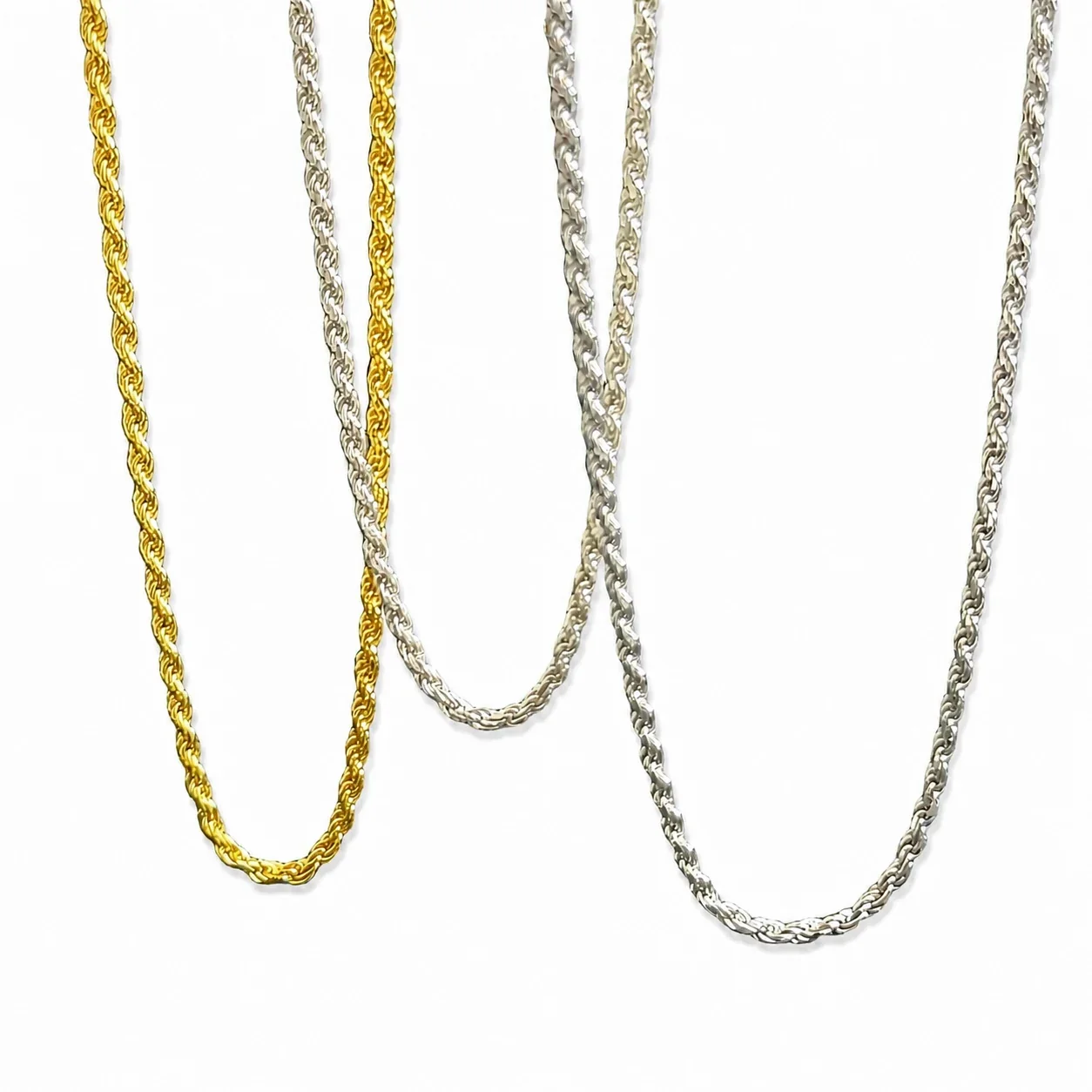
The sterling silver chain types you will meet most often are cable, box, curb, Cuban, rope, figaro, snake, Singapore, wheat, bead, paperclip and herringbone. For a pendant, a cable or box chain is the standard choice; snake and herringbone chains are smooth and flat-looking but can kink under a heavy pendant, so they are usually worn alone or with something light. Width sets the look: 1 to 3 mm reads as slim, 4 to 6 mm as medium, and 7 mm and up as a statement chain. For length, 18 inches (45.7 cm) is one of the most popular women's lengths and 20 inches (50.8 cm) the length men wear most widely. A wider chain of the same style and length weighs more: one chain maker lists an 18-inch sterling curb at about 2.0 g at 1 mm wide and 9.0 g at 3 mm wide.
This page covers the types of necklace chains one by one, a comparison table, how width changes the look and the weight, a necklace chain length guide in inches and centimetres, clasps and extenders, and what the 925 silver and moissanite necklace shelves at AdornTrade actually carry, counted on 4 October 2026. Third-party facts come from a chain manufacturer and supplier (Halstead), two jewellery retailers' published guides (Blue Nile, JTV), an independent jeweller (J.M. Scully), a chain maker's product specifications (Blake Brothers) and the Edinburgh Assay Office; all are listed under Sources.
Sterling silver chain types, one by one
Most chain styles are variations on a few basic constructions: plain wire links (cable), links twisted so they lie flat (curb), links braided into a spiral (rope), and links compressed into a smooth band or tube (snake, herringbone). Halstead's chain glossary groups them this way, and it is a useful way to remember how each one behaves.
Cable and rolo
A cable chain is made of uniform round or oval wire links connected one to the next. Halstead calls cables "the most simple and commonly used jewelry pendant chains", and J.M. Scully calls the cable "the default pendant chain". A rolo (or belcher) chain looks similar, but the links are made from half-round or flat wire, so the chain is heavier than a cable of the same size. Blue Nile notes rolo chains are often used for pendant necklaces and charm bracelets.
Box
A box chain is made of flat, square links folded over and linked so the chain looks like a row of small boxes. Blue Nile describes box chains as "strong and reliable" and "often preferred for heavier pendants". It is one of the two chains J.M. Scully names as a pendant chain, next to cable.
Curb and Cuban
A curb chain is a chain of oval links, each twisted (or "curbed") so the whole length lies flat against the body. A Miami Cuban chain is a very thick, heavy curb, described by Halstead as statement jewelry and "more common for men's jewelry"; Blue Nile describes its links as "thick, tightly packed" with "a smooth, heavy drape". Curb chains are hollow in some ranges and solid in others, and the construction matters more than the name: J.M. Scully points out that "a solid cable chain can outlast a thin hollow curb chain, even though curb has the tougher reputation."
Figaro
A figaro chain repeats three short links followed by one long link roughly as long as the three short ones together. Halstead notes that figaros are usually made from thicker wire than many other chains, so they are a heavier style, and the links are curbed. J.M. Scully describes the figaro as "a pattern meant to be seen", which is why it is usually worn without a pendant.
Rope, Singapore and wheat
A rope chain is a braided assembly of open wire links, named for its resemblance to braided fibre rope. A Singapore chain is a lighter, twisted variation of the rope. A wheat chain, also called spiga, shows a V-shaped wheat-ear pattern from the side; Halstead notes wheat links are typically thicker than the fine links of a standard rope. Blue Nile describes rope chains as "flexible, resilient" and wheat chains as "flexible yet durable". J.M. Scully warns that the Singapore twist is prone to kinking back on itself and catching in knitwear.
Snake and herringbone
A snake chain is a tube of curved plates fitted together, flexible but solid-looking with no open links. A herringbone chain is a flat chain made from a double cable drawn through a flat die, giving a smooth, mirror-like surface. Both look like a band of metal rather than a chain of links, and both share the same weak point. Blue Nile says to avoid heavy pendants on a snake chain because it "can kink under excess weight", and to avoid heavy pendants on herringbone because its flat structure "is not designed to support added weight". Halstead puts it more directly: herringbones "are not flexible and can easily kink", and J.M. Scully adds that a crease in herringbone cannot be pressed out without visible distortion.
Bead (ball) and paperclip
A bead or ball chain is a row of small metal spheres joined by short wire connectors, the same construction as a military dog-tag chain. A paperclip chain is a cable chain whose links have been stretched ("drawn") into long ovals; Halstead notes that drawing a chain also makes it narrower.
Types of necklace chains compared
The widths below are the examples Blue Nile gives in its chain-type guide for its own range, not industry limits. They show the span a buyer can expect to see for each style.
| Chain | Construction | With a pendant? | Example widths (Blue Nile guide) | What the sources note |
|---|---|---|---|---|
| Cable | Uniform round or oval wire links | Yes, the default pendant chain | 1.15 mm (16 in), 1.35 mm (20 and 24 in) | Most commonly used pendant chain (Halstead) |
| Box | Folded flat square links | Yes, including heavier pendants | 1.9 mm (18 in), 3.6 mm (24 in) | "Strong and reliable" (Blue Nile) |
| Curb | Oval links twisted to lie flat | Not stated | 2.9 mm (20 and 24 in), 4.75 mm (18 in) | Hollow and solid curbs differ; solid curb named for daily wear (J.M. Scully) |
| Miami Cuban | Very thick, tightly packed curb | Worn as a statement chain | 6 mm and 7 mm (22 in), 15 mm (24 in) | "Smooth, heavy drape" (Blue Nile); more common in men's jewellery (Halstead) |
| Figaro | 3 short links, then 1 long link, curbed | Worn alone | 2.25 mm (20 in), 4 mm and 7.5 mm (22 in) | Thicker wire, heavier style (Halstead) |
| Rope | Braided open wire links | Not stated | 2 mm | "Flexible, resilient" (Blue Nile); solid rope named for daily wear (J.M. Scully) |
| Singapore | Light twisted rope variation | Not stated | 1.7 mm (18, 20 and 24 in) | Prone to kinking and catching in knitwear (J.M. Scully) |
| Wheat (spiga) | V-pattern braid, thicker links than rope | Not stated | 1.2 mm and 7.9 mm (18 in) | "Flexible yet durable" (Blue Nile); named for daily wear (J.M. Scully) |
| Snake | Tube of curved plates | Light pendants only | 1.1 mm (24 in), 1.5 mm (18 in) | Can kink under excess weight (Blue Nile) |
| Herringbone | Flat band of swaged V links | No | 4 mm (18 and 20 in), 7 mm (18 in) | "Not flexible and can easily kink" (Halstead) |
| Bead (ball) | Metal spheres on wire connectors | Dog tags | Not given | Same construction as a dog-tag chain (Halstead) |
| Paperclip | Cable links drawn into long ovals | Not stated | 2.4 mm and 4 mm (18 in) | "Light yet bold" (Blue Nile) |
Two notes on the table. "Not stated" means the sources above do not say either way, not that the chain is unsuitable. And none of the sources publishes break-strength figures by chain type, so this page does not either. The practical rule they share is solid over hollow, and a sturdier style such as box for anything that will carry weight.
Cuban link vs rope chain, and other common comparisons
- Cuban link vs rope chain. A Cuban is a curb: wide, flat-lying links packed tightly, with a heavy drape and a smooth, continuous look. A rope is a spiral braid of small links that catches light from every angle (Blue Nile). Both are worn alone as men's and unisex chains. At the same width, a Cuban looks flatter and bolder; a rope looks rounder and shinier. Choose a Cuban for a flat, heavy look and a rope for sparkle in a slimmer width.
- Curb vs Cuban. Every Cuban is a curb; not every curb is a Cuban. The name is used for the thicker, tighter-packed end of the curb range, which in the Blue Nile examples runs from 6 mm to 15 mm.
- Box vs snake for a pendant. Both look sleek. The box chain is the safer choice for a pendant of any real weight; the snake chain suits a slider or a very light charm.
- Cable vs paperclip. Same construction, different proportions. Paperclip links are drawn long, and drawing also makes the chain narrower (Halstead); Blue Nile calls paperclip chains "light yet bold".
Chain width: how it changes the look and the weight
JTV's chain guide splits widths into three bands, and they are a fair working vocabulary for a shop:
| Width | Look | Typical use |
|---|---|---|
| 1 to 3 mm | Slim | Pendants, layering, everyday women's chains |
| 4 to 6 mm | Medium | Chains worn alone, men's everyday chains |
| 7 mm and up | Thick | Statement chains, Miami Cuban, wide figaro |
Weight is where width shows up in the price, because sterling silver chain is sold largely on its metal. Blake Brothers publishes average weights for its sterling silver curb chains by width and length:
| Curb chain width | 16 in (40.6 cm) | 18 in (45.7 cm) | 20 in (50.8 cm) | 24 in (61.0 cm) | 30 in (76.2 cm) |
|---|---|---|---|---|---|
| 1 mm | 1.5 g | 2.0 g | 2.3 g | 2.5 g | 3.0 g |
| 1.5 mm | 3.0 g | 3.5 g | 4.0 g | 5.0 g | 6.5 g |
| 3 mm | 7.7 g | 9.0 g | 9.9 g | 10.8 g | 15.0 g |
Tripling the width from 1 mm to 3 mm multiplies the weight of an 18-inch chain by about 4.5, from 2.0 g to 9.0 g. The same maker lists a 5.5 mm sterling curb bracelet at 8.1 g for 8 inches, roughly 1 g per inch. For comparison, it lists a 1.1 mm sterling box chain at 3.0 g in a 20-inch length.
Weight also has a legal side in the UK. The Edinburgh Assay Office states that silver items below 7.78 g do not need a hallmark to be described and sold as silver; heavier silver items sold in the UK do. On the figures above, a 1 to 1.5 mm curb chain is under that threshold at every length up to 30 inches, while a 3 mm curb crosses it somewhere between 16 and 18 inches.
Necklace chain length guide: what necklace length should I get?
One inch is exactly 2.54 cm. Chain length is measured end to end with the clasp closed and included. The positions below follow Blue Nile's women's and men's length guides; where a single length has two names in different charts, both are given.
| Length (in) | Length (cm) | Where it sits | Who wears it |
|---|---|---|---|
| 14 | 35.6 | Close around the neck (collar) | Women; chokers and tennis-style necklaces |
| 16 | 40.6 | Just above the collarbone (choker) | Women; small pendants |
| 18 | 45.7 | Just below the collarbone (princess) | Women's everyday length; sits at the base of the neck on most men |
| 20 | 50.8 | Just below the collarbone on men; upper chest on women (matinee) | Men's most widely worn length |
| 22 | 55.9 | Upper chest | Men; pendants and chains worn alone |
| 24 | 61.0 | Mid chest | Men; statement pieces and wear over clothing |
| 30 | 76.2 | Below the chest (opera to rope) | Long single strands, layering, or doubled |
If you are unsure what necklace length you should get, the quickest test needs only a piece of string: lay it around the neck where the chain should fall and measure it. A pendant hangs below the chain by its own height plus the bail, so a pendant on an 18-inch chain reads lower than the chain alone. Our necklace length chart for retailers goes deeper on lengths, including why chains made in round centimetres (45 cm is 17.7 inches) are sold as round inches.
Clasps and extenders
- Lobster clasp. A spring-loaded hook opened with a lever. Halstead describes lobster clasps as easier to operate for most people, "sturdy and strong for larger pieces of jewelry", and the most popular closure on chain necklaces.
- Spring ring. A round ring with a spring-loaded latch, dating from the early 1900s. Halstead notes spring rings are economical and "best used with lightweight jewelry chains with minimal embellishments".
- Box clasp. A tongue that clicks into a box, a variation of the safety clasp. Halstead notes these are more expensive and decorative and used on higher-end pieces.
- Extender. A short length of chain fixed at one end (3 or 5 cm on our listings), letting the clasp close at several points. A "40 + 5 cm" necklace can be worn anywhere from 15.7 to 17.7 inches.
Match the clasp to the chain. Halstead's rule is to match the size and weight of the clasp to the piece: "Heavier items need sturdier clasps."
Our 925 silver and moissanite necklaces, counted on 4 October 2026
As of 4 October 2026, AdornTrade lists 153 published 925 sterling silver necklaces, 7 published 925 sterling silver chains and 109 published moissanite necklaces set in 925 silver, 269 in all. The counts below come from the product records on that date.
- Chain types named in product titles: box 21, cable 9, snake 8, curb 7, Cuban 4, wheat 3, paperclip 3, and rope, herringbone, rolo and Byzantine 1 each.
- Widths offered as options: the faceted Cuban link chain comes in 2, 3, 4, 5 and 6 mm, each in 45, 50, 55 and 60 cm; the twisted curb chain in 1, 1.2, 1.5, 2 and 3 mm. Other fixed-width chains include a 3 mm curb, a 5 mm faceted curb, a 6 mm Cuban, a 7 mm diamond-cut Cuban and a 6 mm ribbed snake chain.
- Length as a selectable option: 46 listings let the buyer pick a length. Every one of those length options is written in centimetres. The most offered lengths are 45 cm (41 listings), 50 cm (39), 55 cm (37) and 60 cm (36), followed by 40 cm (11), 65 cm (7), 41 cm (6), 70 cm (2), and 35 and 75 cm (1 each).
- Fixed-length pendant necklaces: of the 149 silver necklaces with a length record, 103 are recorded in the 41 to 50 cm band (16.1 to 19.7 inches); of the 96 moissanite necklaces with a length record, 77 are in that band.
- Extenders: 6 silver necklaces are sold as a base length plus extender, as 40 + 5, 45 + 5 or 40 + 3 cm.
- Clasps: of the 79 listings that record a closure, 37 use a lobster clasp, 33 a spring ring and 3 a hook; 10 mention an extender chain.
The range by style, with tier prices for 3 and 8 pieces, is on the 925 sterling silver necklaces wholesale page, and the stone-set range is under wholesale moissanite jewelry.
Notes for retailers: explaining chains to customers
- Tag width and length in both units. "3 mm curb, 45 cm / 17.7 in" answers the two questions customers ask before they ask them.
- Steer pendant buyers to cable or box. When a customer wants a heavy pendant on a snake or herringbone chain, the sources above point the same way: suggest a box chain, which Blue Nile names for heavier pendants.
- Show weight on wide chains. On men's Cuban and curb chains, grams explain the price better than any description. A 3 mm curb at about 9 g and a 1 mm curb at about 2 g are different products, not different sizes of one product.
- Stock the middle lengths deepest. For women, 16 to 20 inches; for men, 20 to 24 inches.
- Care is the same for every style. Sterling silver darkens over time as silver sulphide forms on the surface; see how to clean sterling silver jewelry.
FAQ
What is the strongest type of necklace chain?
None of the sources here publishes break-strength figures by style. What they agree on: solid beats hollow, and box, wheat, rope, Franco and solid curb in sensible widths are the styles named for daily wear. Snake, herringbone and Singapore are the ones flagged as prone to kinking.
What chain is best for a pendant?
Cable or box. Cable is the standard pendant chain; box is the one recommended for heavier pendants.
What width should a men's chain be?
For a chain worn alone, 4 to 6 mm is the medium band and 7 mm and up the statement band. Blue Nile's Miami Cuban examples run from 6 mm to 15 mm.
Is a 45 cm chain the same as 18 inches?
Close but not equal. 45 cm is 17.7 inches, and 18 inches is 45.7 cm.
Accuracy reviewed by: Alex Hou, Founder, AdornTrade
Sources
- Halstead — Types of Jewelry Chain Link Styles (chain glossary: cable 'most simple and commonly used jewelry pendant chains'; rolo heavier than cable; curb/Miami Cuban; figaro 3 short + 1 long, thicker gauge; rope/Singapore/wheat; snake; herringbone 'not flexible and can easily kink'; ball chain; paperclip = drawn cable)
- Blue Nile — 25 Types of Chains: A Guide to Necklace Styles (box 'often preferred for heavier pendants'; snake and herringbone: avoid heavy pendants; example widths per style)
- J.M. Scully Jewelers — Types of Necklace Chains: 15 Styles and Their Best Uses (cable 'the default pendant chain'; solid cable vs hollow curb; daily-wear styles; Singapore and herringbone kinking)
- JTV — The Ultimate Guide to Chain Necklaces (width bands: slim 1–3 mm, medium 4–6 mm, thick 7 mm and up)
- Blue Nile — Necklace Length Chart (14 in collar; 14–16 in choker; 18 in princess, just below the collarbone; 20–24 in matinee; 24–30 in opera; 30 in+ rope)
- Blue Nile — The Complete Guide to Chain Length for Men (18 in base of neck; 20 in most widely worn; 22 in upper chest; 24 in mid-chest)
- Blake Brothers — Sterling Silver CURB 035 (1mm) chain: average weight 16 in 1.5 g, 18 in 2.0 g, 20 in 2.3 g, 24 in 2.5 g, 30 in 3.0 g
- Blake Brothers — Sterling Silver CURB 080 (3mm) chain: average weight 16 in 7.7 g, 18 in 9.0 g, 20 in 9.9 g, 24 in 10.8 g, 30 in 15.0 g (1.5 mm, box 019 and 5.5 mm bracelet figures on sibling product pages)
- Halstead — Types of Jewelry Clasps & Closures (spring ring for lightweight chains; lobster 'sturdy and strong'; safety/box clasps; 'Heavier items need sturdier clasps')
- Edinburgh Assay Office — Complying with the Hallmarking Act (silver items below 7.78 grams do not require a hallmark)
From the catalogue