Your shopping bag is empty.
Explore productsBuyer guides
Ring Size Chart: US, UK, EU, Hong Kong and Japan Sizes in mm
By Alex Hou, Founder, AdornTrade 2026-10-04 13 min read
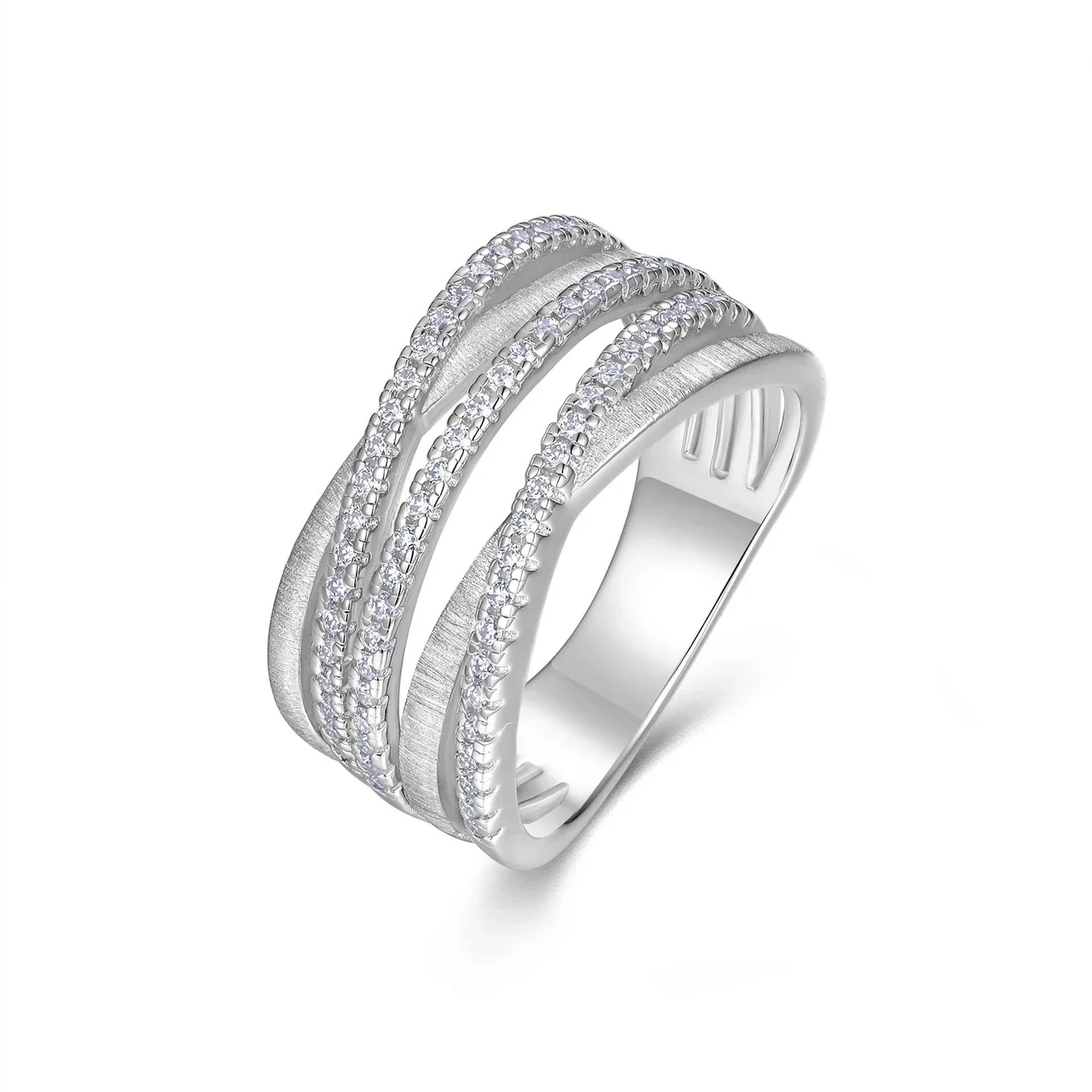
A ring size is a measurement of the inside of the ring, and every national system is a different way of writing that one number. A US size 7 ring has an inner diameter of 17.3 mm and an inner circumference of 54.4 mm; that is N½ in the UK and Australia, size 54 in Europe under ISO 8653, size 15 in Hong Kong and size 14 in Japan. The ring size chart below converts US 3 to US 13 in half sizes into all of these systems, with both millimetre columns, and the rest of this page explains how to measure ring size at home and why the same "mm" figure gets read two different ways.
Ring size conversion chart: US, UK, EU, Hong Kong and Japan
Inner diameter (Ø) is measured straight across the inside of the ring. Inner circumference is the distance around the inside. The two are tied by arithmetic, not by a second measurement: circumference = diameter × π (3.1416), so diameter = circumference ÷ 3.1416. Every row below passes that check to within the 0.1 mm rounding.
| US & Canada | UK & Australia | Inner diameter (mm) | Inner circumference (mm) | EU / ISO 8653 size | Hong Kong (circ. mm) | Japan (circ. mm) |
|---|---|---|---|---|---|---|
| 3 | F | 14.1 | 44.2 | 44 | 6 (44.3) | 4 (44.0) |
| 3.5 | G | 14.5 | 45.5 | 45 | 7 (45.5) | 5 (45.0) |
| 4 | H | 14.9 | 46.8 | 47 | 8 (46.5) | 7 (47.1) |
| 4.5 | I | 15.3 | 48.0 | 48 | 9 (47.7) | 8 (48.2) |
| 5 | J½ | 15.7 | 49.3 | 49 | 10–11 (48.7 / 49.9) | 9 (49.2) |
| 5.5 | K½ | 16.1 | 50.6 | 51 | 12 (50.9) | 10 (50.3) |
| 6 | L½ | 16.5 | 51.9 | 52 | 13 (52.1) | 12 (52.4) |
| 6.5 | M½ | 16.9 | 53.1 | 53 | 14 (53.1) | 13 (53.4) |
| 7 | N½ | 17.3 | 54.4 | 54 | 15 (54.3) | 14 (54.5) |
| 7.5 | O½ | 17.7 | 55.7 | 56 | 16 (55.6) | 15 (55.5) |
| 8 | P½ | 18.1 | 57.0 | 57 | 17 (56.5) | 16 (56.6) |
| 8.5 | Q½ | 18.5 | 58.2 | 58 | 19 (58.7) | 18 (58.6) |
| 9 | R½ | 18.9 | 59.5 | 60 | 20 (59.7) | 19 (59.7) |
| 9.5 | S½ | 19.4 | 60.8 | 61 | 21 (60.9) | 20 (60.7) |
| 10 | T½ | 19.8 | 62.1 | 62 | 22 (61.9) | 21 (61.8) |
| 10.5 | U½ | 20.2 | 63.3 | 63 | 23 (63.1) | 22 (62.8) |
| 11 | V½ | 20.6 | 64.6 | 65 | 24 (64.1) | 24 (64.9) |
| 11.5 | W½ | 21.0 | 65.9 | 66 | 26 (66.3) | 25 (66.0) |
| 12 | X½ | 21.4 | 67.2 | 67 | 27 (67.5) | 26 (67.1) |
| 12.5 | Y½ | 21.8 | 68.5 | 68 | 28 (68.5) | 27 (68.1) |
| 13 | Z½ | 22.2 | 69.7 | 70 | 29 (69.7) | 29 (70.3) |
To convert a US to UK ring size, read across the first two columns: US 6 is L½, US 7 is N½ and US 9 is R½. Hong Kong and Japanese whole sizes do not line up with US half sizes, so those two columns give the nearest size and, in brackets, that size's own circumference. Compare the bracketed figure with the circumference column to see how far off the nearest size is. US 5 sits exactly between Hong Kong 10 and 11 (0.6 mm from each), so the chart shows both.
Where each column comes from, and where sources disagree
- US and Canada. One whole US size is 0.032 in, or 0.8128 mm, of inner diameter, and inner diameter in mm = 11.63 + 0.8128 × US size. That gives 2.55 mm of circumference per whole size and 1.28 mm per half size. Chow Sang Sang's printed chart (US 7 = 54.3 mm, US 9 = 59.7 mm) and Blue Nile's chart (US 6 = 16.5 mm diameter) agree with the formula to within 0.2 mm.
- EU / ISO 8653. ISO 8653:2016 defines ring size as "the circumference of the bigger cylinder that could be inserted in the ring", in millimetres. Its reference ring stick runs from size 41 to size 76; size 51 corresponds to a stick diameter of 16.23 mm and size 61 to 19.42 mm, each with a tolerance of ±0.02 mm. The EU column above is the circumference rounded to the nearest whole millimetre.
- UK and Australia. British Standard 6820:1987 made the letter scale metric: size C is 40 mm of circumference and each letter adds 1.25 mm, so a half letter is 0.625 mm. The letters in the chart are the ones printed on Blue Nile's international chart and Wikipedia's equivalency table, which agree at every half size from US 3 to US 12 except US 8.5. Checked against the BS 6820 arithmetic, every letter is within 0.53 mm of the US size beside it, under one half letter. The largest gaps are at US 3 to 4.5, where the UK letter is about 0.5 mm smaller; a UK customer at those sizes who measures between two letters should take the larger one. Three rows needed a choice. At US 8.5 Wikipedia prints Q¼, but Blue Nile prints Q½, BS 6820 has half-letter steps, and Q½ (58.1 mm) is 0.1 mm from US 8.5, so the chart uses Q½. At US 12.5 Blue Nile prints Z and Wikipedia Y½; the two letters sit 0.29 mm above and 0.33 mm below US 12.5, and the chart keeps Wikipedia's Y½. At US 13 Blue Nile leaves the UK cell empty because the size falls between Z½ and Z+1; the chart gives Z½, as Wikipedia does.
- Hong Kong. An HK ring size chart is a lookup table, not a formula: the steps between whole sizes in Chow Sang Sang's chart range from 0.9 mm to 1.3 mm of circumference. The chart above uses Chow Sang Sang's published values. Our own listings follow a factory chart we hold from one of our Chinese suppliers. Of the 19 Hong Kong sizes used on our listings, 13 match Chow Sang Sang to the decimal and 6 differ by 0.2 to 0.3 mm (Hong Kong 7, 14, 16, 18, 20 and 22). A 0.3 mm gap is 0.12 of a US size, small enough that the two charts describe the same scale rounded differently. Blue Nile's chart also has a Hong Kong column, and it runs about one size lower than Chow Sang Sang's: it puts US 7 (54.4 mm) at Hong Kong 14, where Chow Sang Sang's Hong Kong 14 is 53.1 mm and its 15 is 54.3 mm. We follow Chow Sang Sang because it is a Hong Kong jeweller publishing the measurements of its own sizes, and because the independent factory chart matches it.
- Japan. The chart uses the table published by the Japanese jeweller 4°C, which starts at size 1 = 13.0 mm inner diameter (40.8 mm circumference) and adds about 1/3 mm of diameter, or about 1 mm of circumference, per size, reaching size 30 at 22.7 mm. Chow Sang Sang's chart also has a Japan column and places US 7 at Japan 13.5 rather than 14. We use 4°C because it is a Japanese company stating the measurement of its own sizes; Blue Nile's combined China/Singapore/Japan column also puts US 7 at 14, matching 4°C.
- Mainland China. Chow Sang Sang prints a separate mainland China column that does not match the Hong Kong numbers: Hong Kong 15 (54.3 mm) is mainland 14, and Hong Kong 16 (55.6 mm) is mainland 15.5. The two scales meet at 19 and 20. The Chinese factories behind our own fixed-size rings write their sizes in Hong Kong or US numbers, which is why the chart lists Hong Kong rather than mainland sizes.
How to measure ring size at home
There are two starting points: a ring that already fits the intended finger, or the finger itself. Blue Nile recommends measuring 3 to 4 times to rule out a wrong reading; Chow Sang Sang says to measure several times.
Measuring a ring that already fits
- Measure the inner diameter straight across the inside, at the widest point, from inner edge to inner edge. Do not include the metal.
- Use calipers that read to 0.1 mm. A half US size is only 0.41 mm of diameter, so a school ruler marked in whole millimetres cannot separate a 6 from a 6.5.
- Alternatively, print a ring-circle chart. Chow Sang Sang's printable chart has a 30 mm check line and Chow Tai Fook's has a 50 mm check line; print at 100% scale (Chow Tai Fook specifies page scaling set to "none" on A4), confirm the line measures exactly, then lay the ring over the circles and match the inner edge.
- If the ring falls between two sizes, take the larger. Chow Sang Sang, Chow Tai Fook and Blue Nile all give this instruction.
Measuring the finger with a paper strip or string
Wrap a strip of paper around the base of the finger, mark where it overlaps, lay it flat and measure the length in millimetres. That length is a finger circumference, so read it against the circumference column, not the diameter column. Two numbers show why this method needs care. A whole US size is 2.55 mm of circumference, so an error of 1 mm in where you place the mark moves the result by 0.4 of a size. Blue Nile advises against string and paper altogether because both "can stretch or twist". If you use a strip anyway, use paper rather than string, keep it flat and snug without pulling, and repeat it 3 times.
Knuckles, time of day, temperature and wide bands
- Knuckle. The ring has to pass the knuckle before it sits at the base. If the knuckle is noticeably larger than the base of the finger, measure both and choose a size between the two, as Blue Nile advises.
- Time of day and temperature. Blue Nile's sizing guide says finger size changes with the time of day and the weather, that fingers are smaller in the early morning and when cold, and that the best time to measure is late in the day, when the fingers are warm.
- Wide bands. A wider band covers more of the finger and feels tighter at the same size. Blue Nile advises going up half a size for wider styles: that is 1.28 mm more circumference, or 0.41 mm more diameter. For scale, the International Gem Society puts typical engagement ring bands at 2 to 6 mm wide, with 3 to 4 mm being standard, so a band above 6 mm is wider than that typical range.
- Professional measurement. ISO 8653 measures a ring by sliding it down a metric ring stick "without any external force" and reading where it stops. For finger sizing it refers to a set of gauge rings, one per size, made to the same diameters and tolerances. A jeweller's sizing ring set is the in-store version of this.
Why the same millimetre figure gets read wrong
US ring size charts print the inner diameter as their millimetre figure: Blue Nile's printable sizer labels US 6 as 16.5 mm. European and Asian charts are built on circumference: ISO size 52, Hong Kong 13 = 52.1 mm. A bare "mm" next to a size number therefore has two possible meanings, and they differ by a factor of 3.14. Nobody confuses 16.5 with 51.9 once both are labelled, but a buyer comparing an unlabelled figure from one chart with a labelled figure from another can.
The bigger trap is the bare size number. Here is what "size 17" means in five systems:
| System | How "17" is defined | Inner circumference (mm) | Nearest US size |
|---|---|---|---|
| Germany, Netherlands (diameter system) | 17 mm inner diameter | 53.4 | 6.6 |
| Hong Kong (Chow Sang Sang) | Table entry | 56.5 | 7.8 |
| Italy, Spain, Switzerland | Circumference minus 40 mm | 57.0 | 8.0 |
| Japan (4°C) | Table entry | 57.6 | 8.25 |
| US | Beyond the US 16 at which Wikipedia's equivalency table ends | – | – |
The spread between the smallest and largest reading of "17" is 4.2 mm of circumference, or 1.6 US sizes. A size number is only meaningful with its system name attached.
How to read AdornTrade ring size options
For this reason our fixed-size rings carry the system, the inner diameter and the inner circumference in one label, in this format:
HK 10 · inner Ø 15.5 mm (48.7 mm circ.)
- HK 10 is the size as the supplier sized it: Hong Kong size 10. US-sized rings start with "US", for example US 7 · inner Ø 17.3 mm (54.4 mm circ.).
- inner Ø 15.5 mm is the inner diameter. Compare it with the diameter of a ring that already fits, or with the diameter column in the chart above.
- (48.7 mm circ.) is the inner circumference. Compare it with a paper-strip measurement of the finger, or with an ISO/EU size.
The diameter is the circumference divided by π, so the two numbers in one label always agree (15.5 × 3.1416 = 48.7). HK 10 at 15.5 mm is close to US 4¾. A buyer who read "10" as a US size would expect 19.8 mm, more than five US sizes larger.
As of 4 October 2026, 95 published rings on AdornTrade carry labels in this format, with 683 size values in total: 61 rings are sized in US numbers and 34 in Hong Kong numbers. US labels run from US 3.5 to US 12, and Hong Kong labels from HK 5 to HK 25. Of those 95 rings, 66 are on the moissanite rings shelf and 13 on the sterling silver rings shelf; the other 16 are stainless steel and copper. A further 216 published rings are listed with the size option "Adjustable".
For retailers: choosing a size run when you buy stock
Every extra size you stock in a fixed-size style is another line of inventory. Three published or recorded data points help set the run:
- Blue Nile, a US online jeweller, states in its sizing guide that women's rings range from US 3 to 9, that the most commonly purchased women's sizes there are US 5 to 7, and that US 6 is the most popular. For men it gives a range of US 8 to 14, most commonly purchased sizes of US 8 to 10½, and US 9 as the most popular.
- A Chinese factory size chart we hold from one of our 925 silver suppliers notes women at Hong Kong 10 to 15 and men at Hong Kong 17 to 22. Using Chow Sang Sang's conversions, that is about US 4¾ to 7 for women and US 7¾ to 10 for men, in line with Blue Nile's ranges.
- What suppliers make. On AdornTrade as of 4 October 2026, US 7 is offered on 59 rings, US 8 on 56, US 9 on 52, US 6 on 50 and US 5 on 44, while US 10 appears on 5 rings and US 11 and 12 on 1 each. The Hong Kong-sized rings cluster the same way: HK 9 to HK 20 each appear on 30 to 34 rings, and HK 21 to HK 25 on 1 to 4.
Read together, a women's fixed-size run of US 5, 6, 7 and 8 covers Blue Nile's most commonly purchased women's sizes (US 5 to 7) plus one size above, and each of those four sizes is offered on 44 to 59 of the US-sized rings in our catalogue. A men's run of US 8, 9, 10 and 11 covers Blue Nile's most commonly purchased men's sizes (US 8 to 10½). Your own sales history will refine the split once you have a season of it. Adjustable styles are the other route: one SKU per design, no size conversion and no size-based exchange, at the cost of a band that has to bend to fit.
When you explain sizes to a customer, give them the millimetres, not just the number. A customer who knows their inner diameter can buy from any country's chart. For pricing and the sizes stocked on 925 silver styles, see wholesale 925 sterling silver rings; for a closer look at why supplier size numbers above 13 are not US sizes, see our guide to US and Asian ring numbering.
Accuracy reviewed by: Alex Hou, Founder, AdornTrade
Sources
- ISO 8653:2016 — Jewellery — Ring-sizes — Definition, measurement and designation (ISO catalogue page)
- ISO 8653:2016 preview (iTeh) — ring-size = 'circumference of the bigger cylinder that could be inserted in the ring'; ring stick sizes 41–76; size 51 = 16.23 mm, 61 = 19.42 mm, ±0.02 mm; ring slid down 'without any external force'
- Wikipedia — Ring size (US: 0.032 in per size, d = 0.8128 × s + 11.63; BS 6820:1987: C = 40 mm, 1.25 mm per letter; ISO sizes used in Austria, France, Belgium, Nordic countries; Italy/Spain/Switzerland = circumference − 40; Germany/Netherlands = diameter; US scale also in Mexico; equivalency table)
- Chow Sang Sang — Ring Size Guide (PDF, 2017): circumference/diameter table for Hong Kong, mainland China, US & Canada, Japan, Taiwan; 30 mm print check; choose the larger size
- Chow Tai Fook — Rings Size Guide (PDF): print on A4 with page scaling 'none', 50 mm check line, choose the larger size
- 4°C Bridal — リングサイズの測り方 (Japanese sizes 1–30: inner circumference and inner diameter; size 1 = 13.0 mm / 40.8 mm)
- Blue Nile — How to Measure Your Ring Size (wider styles: go up half a size; measure at end of day; knuckle: choose between; popular sizes women 6, men 9)
- Blue Nile — How to Determine Your Ring Size / International Ring Size Chart (2012 printable PDF, copy hosted by zilvera.nl): US sizer in mm, UK/HK/CN-SG-JP columns, measuring tips, US size ranges
- International Gem Society — How Wide Should My Engagement Ring Band Be? (typical 2–6 mm, 3–4 mm standard)
From the catalogue